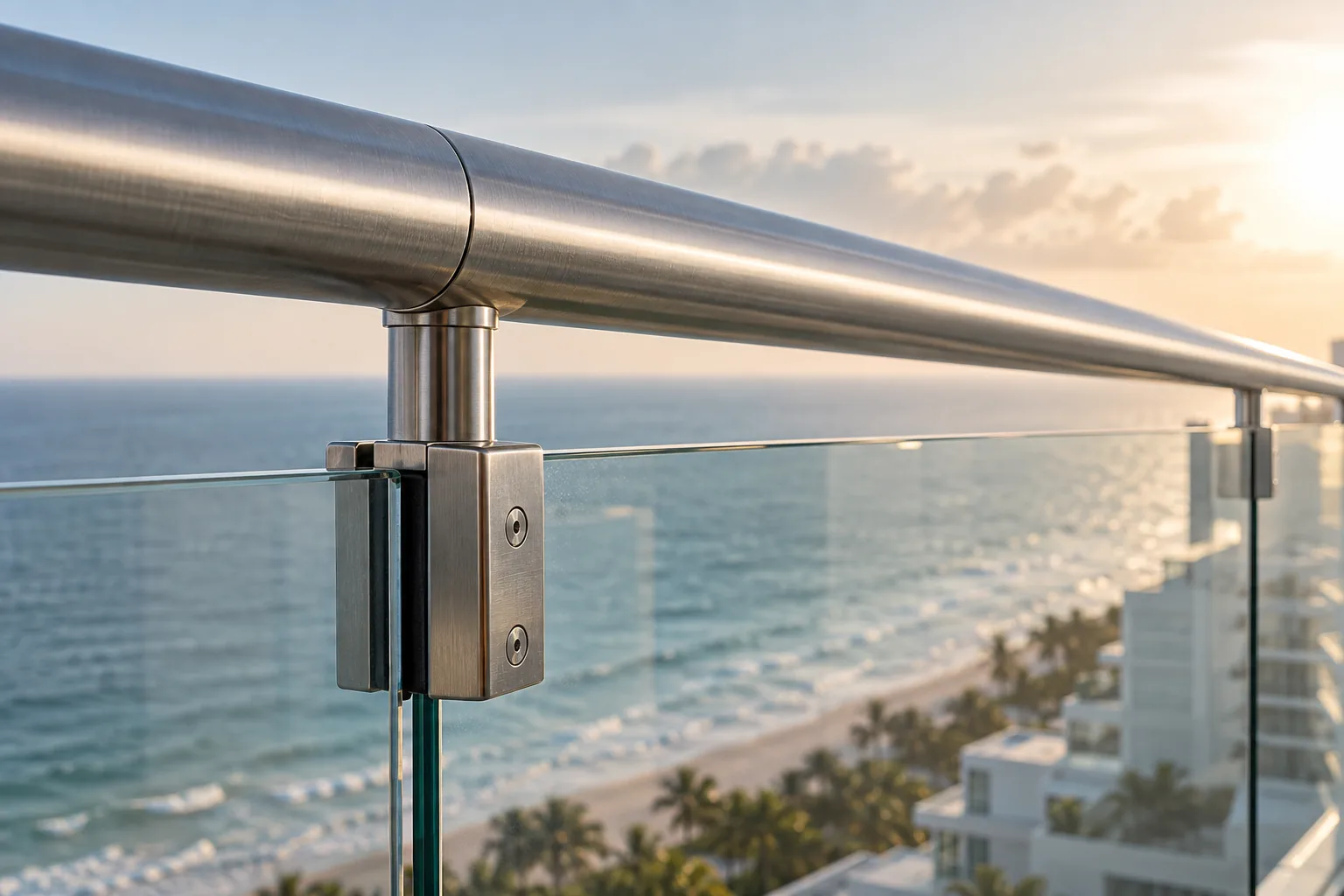
Type 316 stainless resists salt; type 304 does not resist it for long. Within a few miles of the Atlantic that difference shows up as brown streaks on a railing about two years after it was installed, and no cleaner takes the late stage of it off.
One element. Both are chromium-nickel stainless steels and both look the same brushed or polished. Type 316 adds two to three percent molybdenum, and molybdenum is what holds off chloride attack. Salt is chloride. That is the whole argument, and it is why 316 is called marine grade while 304 is the general-purpose one you find indoors and inland.
02
What failure actually looks like
Not a hole. It starts as tea staining — a thin brown film that appears first at welds, at crevices, and under clamps, usually on the seaward side of the run. Early on it is cosmetic and comes off with a proper stainless cleaner. Left alone it becomes pitting, and pitting does not clean off; it has to be ground out or the part replaced. On a glass railing the part that stains is also the part everyone touches.
03
The weakest component sets the outcome
A 316 post held on with 304 screws is a 304 railing. Chloride collects wherever water sits and cannot dry: under base-shoe covers, inside clamp jaws, behind gaskets, at anchor points drilled into the deck. Those are exactly the places nobody inspects. Ask for the grade component by component — posts, standoffs, clamps, spigots, fasteners and the anchors buried in the substrate — rather than for the railing as one word.
04
Finish is part of the corrosion answer
A smoother surface holds less salt. A mirror polish sheds it and shows every fingerprint; a brushed satin finish hides marks but its grain gives salt somewhere to sit. Electropolishing goes further and restores the passive layer after fabrication. Welds deserve their own question: welding burns off the chromium-rich skin locally, and unless the weld is cleaned and passivated afterwards it becomes the first place the railing stains.
05
What to write in the specification
Five lines make two quotes comparable. The grade for each component. The finish, named rather than described. Whether welds are pickled and passivated. Whether fasteners and anchors match the visible hardware. And the manufacturer’s care schedule, because that is what any coastal claim will be measured against later.
Fresh water, a soft cloth, no abrasives, no chlorine-based cleaner. Near the ocean that means roughly monthly; a few miles inland, a few times a year; on an oceanfront balcony that catches spray, more often than feels reasonable. Rain is not a rinse — it wets the salt and leaves it there. This one habit does more for the look of coastal hardware than any grade upgrade.
Which system suits a project depends on the surface it fixes to and how the space is used. Send photographs or a plan and we will go through the options against your own site rather than in general.