

QUESTIONS · GLASS RAILINGS
Glass railings,
answered plainly.
The questions that come up before a railing is specified — about the systems, the glass itself, and what South Florida does to an installation over time.
Broward · Miami-Dade · Palm Beach
What are my mounting options?
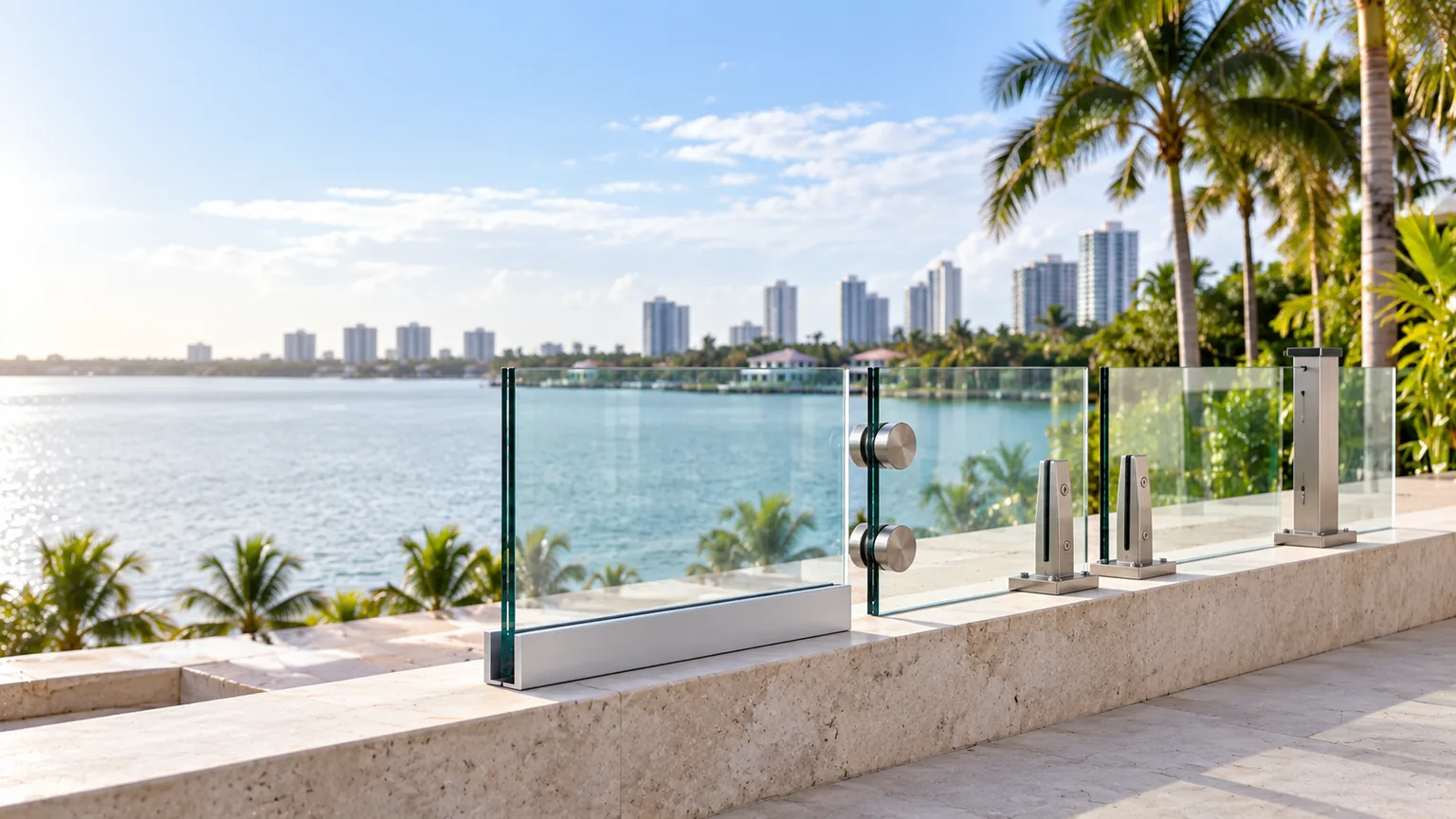
Four in common use. A base shoe holds the glass in a channel at the floor for an uninterrupted line. Standoffs pin the glass to the side of the structure and keep the walking surface clear. Spigots hold each panel at two points and read as minimal hardware on a deck. Posts frame the glass and are often the most economical over a long run. Which one suits depends on what you are anchoring into as much as on the look.
Compare the systemsWhat glass goes into a railing?
Usually laminated — two panes bonded to an interlayer so the pieces stay in place if the glass breaks. The interlayer matters as much as the glass: PVB is the common one, while a stiffer ionoplast interlayer such as SentryGlas transfers load better between the panes and holds up better where the edge of the glass is exposed to weather. The construction is confirmed per project against the code path and the loads, not chosen from a default.
How laminated glass worksDo I have to have a top rail?
Not always, but the alternative has to be earned. The code permits a guard without a continuous top rail only where the assembly has been tested or engineered for it. A frameless look is achievable; it is a specification decision made with the drawings, not a preference you can apply to any panel.
Guards and handrailsHow tall does the railing have to be?
Guard height is measured from the walking surface, or from the stair nosing line on a stair. The commonly referenced baseline is 42 inches, with residential exceptions that differ by occupancy and location. We confirm it against the code your jurisdiction has adopted rather than carrying a dimension from another project.
What hardware survives near the ocean?
Salt air is the deciding factor within a few miles of the water. Type 316 stainless — often called marine grade — resists chloride corrosion considerably better than 304, which is why it is the usual specification for exposed coastal hardware. Powder-coated aluminum is another route. Either way the fastener, the anchor, and the substrate all matter, not just the visible clamp.
Handrails and hardwareCan the glass be tinted or frosted?
Yes. Tinted, low-iron, frosted, and textured glass are all available for railings, and the choice changes how much the railing reads as a surface rather than as air. Low-iron glass — sold under names such as Starphire — removes the green cast you see in the edge of ordinary glass, which is most noticeable on thick panels and long runs.
Glass and visual finishesHow much does a glass railing cost?
It moves with the system, the glass construction, panel sizes, hardware, what you are anchoring into, access to the work area, and whether engineering or permit documents are required. Any number quoted before those are known is a guess. We would rather look at the site and give you an itemized estimate you can compare against another one.
Get an itemized estimateWill it show every fingerprint?
Glass shows what lands on it, and a railing beside a pool or a door gets touched. A protective coating such as EnduroShield fills the microscopic texture of the surface so water and residue release more easily, which makes routine cleaning faster. It reduces the work; it does not remove it.
Care and maintenanceCan you replace the glass in an existing railing?
Sometimes. It depends on the system already installed, whether the hardware is still available, and whether the existing assembly meets what the code now requires. Send photographs of the base detail and the top of the panel and we can tell you whether replacement is realistic before anyone comes out.
How long does a railing take?
The honest answer is that it depends on the system, the glass, whether the panels are stock or made to size, and whether approvals are involved. We give you the sequence and the expected dates for your project in writing before you commit, rather than a number on a web page that would not apply to you.
KEEP EXPLORING
Bring the details together.
YOUR NEXT STEP
Still have a question?
If yours is not answered here, ask it. The answer usually depends on your site — the surface, the span, the finishes around it — and we would rather look than guess.
(754) 704-2777